
What happens to a business when a key director has a stroke? Gary’s story
Gary is a composite. He doesn’t exist, but I meet a version of him in almost every firm I visit.
Meet Gary
Gary co-owns a groundworks business with his mate Steve. He prices every job and knows every client by first name. Half the subbies only turn up because Gary rang them.
On a Tuesday morning, Gary has a stroke. He’s 48.
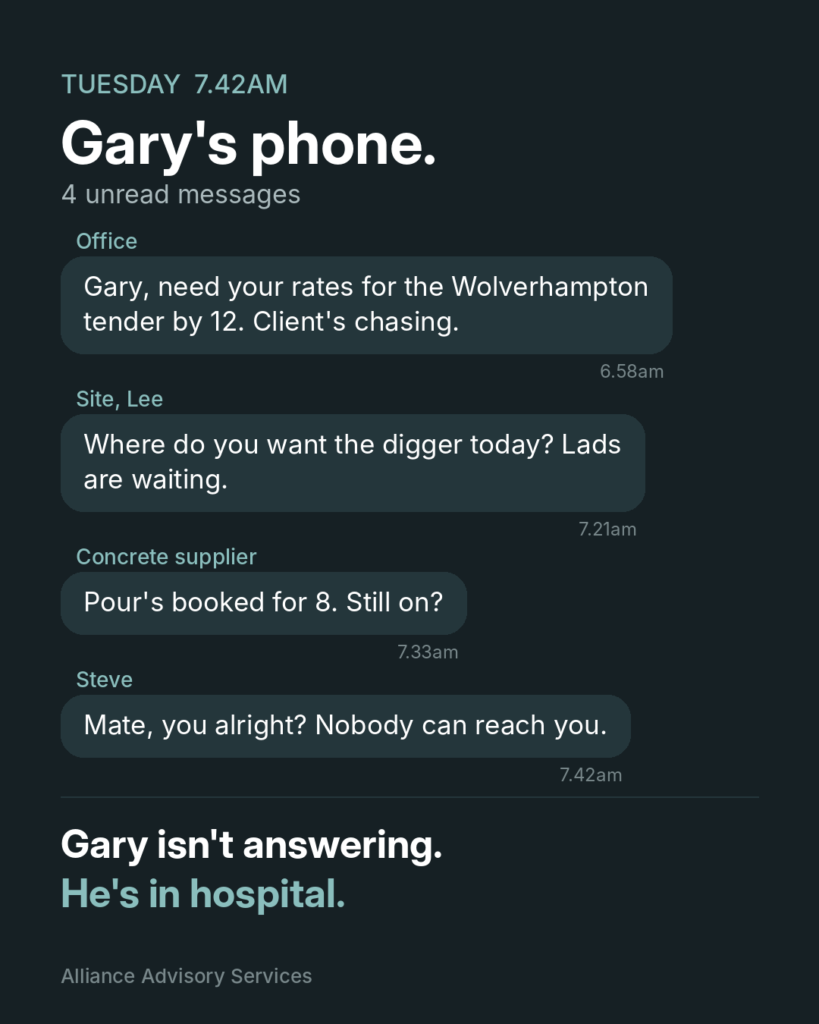
By Friday, nobody can find his rates for the Wolverhampton tender. By the end of the month, two clients have quietly gone elsewhere. Nobody did anything wrong. Everything simply lived in Gary’s head.
Then the money side catches up
Work slows down, so cash slows down. The overdraft is due for review, and the bank rings to ask who’s running things now.
Then someone remembers the personal guarantee Gary signed five years ago, and the charge over his family home. Nobody is saying the bank will take the house tomorrow. But Steve now has to find out exactly what the business owes, what Gary personally guaranteed, and what could happen if the company can’t repay.
So it isn’t just the business under pressure. It’s Gary’s family, while he’s lying in a hospital bed.
I’ve sat with directors who couldn’t tell me, there and then, what they had personally guaranteed. It’s one of the first things I ask.
Then the question of who owns what
Gary never made it back to work. Six months after his stroke, he passed away.
There was no shareholder agreement setting out what should happen next. Under his will, his half of the business passed to his wife, Karen.
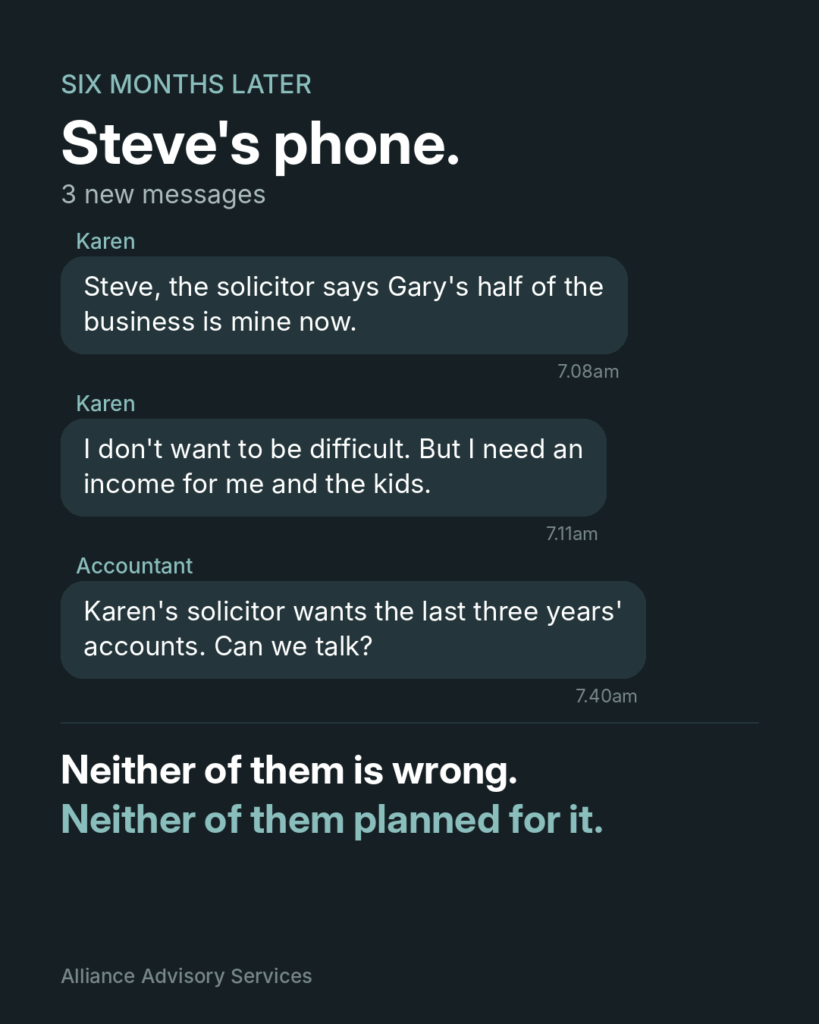
Karen has never set foot on a building site. She needs an income for herself and the kids. Steve now co-owns a company with someone who needs money out of it, while he’s fighting to keep it alive.
Neither of them is wrong. Neither of them planned for it.
Why this happens in good businesses
None of this comes from bad management. It comes from three conversations that most owners put off:
- Who could step in? If your best person couldn’t work for six months, who would price the jobs and keep the clients?
- What have you signed for personally? Loans, overdrafts and leases often come with guarantees that outlast everyone’s memory of them.
- What happens to the shares? Without an agreement in place, ownership can pass to someone who never wanted to run the business.
Five questions to ask about your own business this week
- Who is your Gary, the person the business can’t run without?
- If they were off for six months, what would stop first: pricing, clients or cash?
- What have you, or your fellow directors, personally guaranteed?
- Is there a shareholder or partnership agreement, and does it say what happens on death or long-term illness?
- If the worst happened, would your family and your business partner want the same thing?
If you can’t answer all five with confidence, you’re not alone. Most of the owners I speak to can’t, the first time.
Find out where your business stands
I built a free 12 question Business Resilience Health Check that shows you where the gaps are in about five minutes. You answer the questions yourself and get your results straight away.
Des Richards, Strategic Protection Adviser, Alliance Advisory Services